
Piezoelectric Ceramics Industry Forum
Piezoelectric Ceramics Industry Forum
8th Aibang Precision Ceramics Industry Chain Exhibition
August 28, 2026
Hall 7, Shenzhen Bao'an Convention and Exhibition Center
Conference Background
Piezoelectric ceramics are functional ceramic materials capable of interconverting mechanical and electrical energy by utilizing the piezoelectric effect. When subjected to mechanical stress, the material undergoes polarization due to the relative displacement of internal positive and negative charge centers; this generates the piezoelectric effect, resulting in the appearance of opposite bound charges at the material's ends and conferring high sensitivity. Characterized by high sensitivity, stability, and reversibility, piezoelectric ceramics are used to manufacture a wide range of components—such as sensors, actuators, ceramic filters, ceramic frequency discriminators, and infrared detectors—and find extensive application in fields including ultrasonic equipment, medical instruments, automotive electronics, and 5G/6G communications.
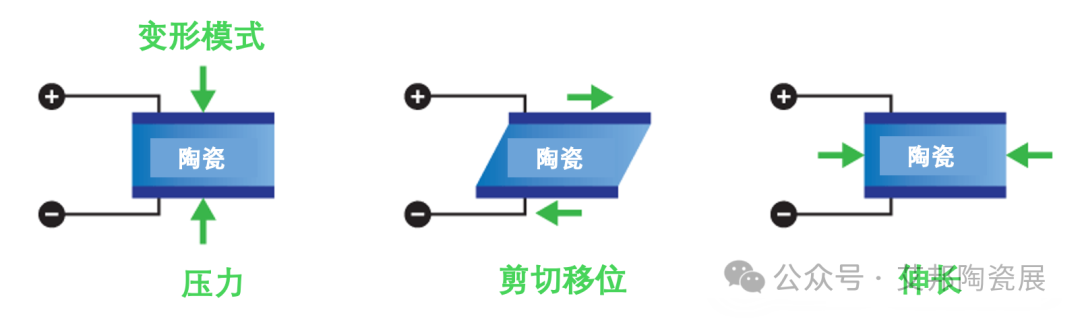
Schematic diagram of the operating principle of piezoelectric ceramics (Source: THORLABS)
Commonly used piezoelectric ceramic materials include barium titanate, lead titanate, aluminum nitride, lead zirconate, zinc oxide, and lead zirconate titanate (PZT) binary and ternary systems (the latter formed by adding ABO3 compounds to the PZT binary system, where A represents a divalent metal ion and B represents a tetravalent metal ion or a combination of ions with a total valence of +4). Furthermore, adding a fourth or additional compounds to a ternary system yields multicomponent piezoelectric ceramics, alongside lead-free piezoelectric ceramic materials.
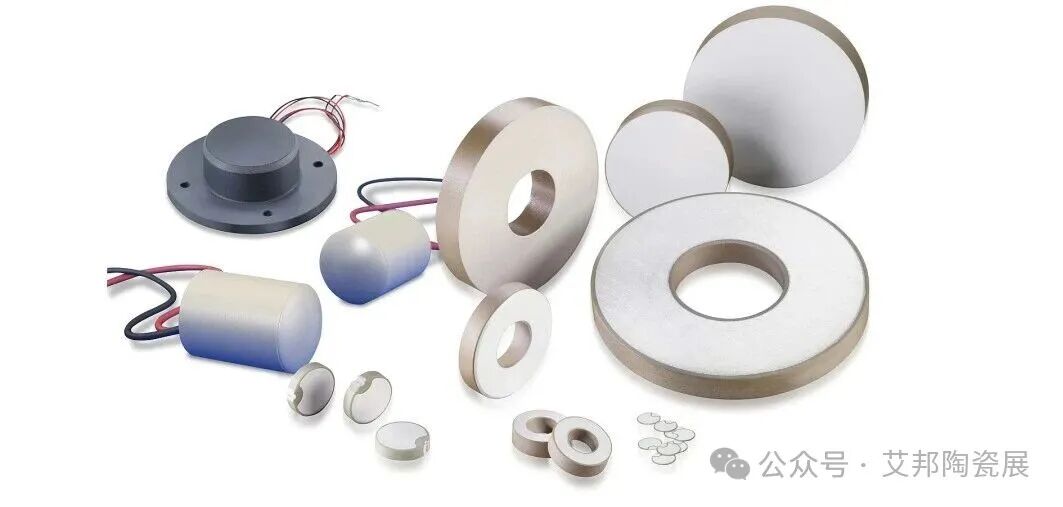
Sailangtaike Piezoelectric Ceramic Products
Synthesis methods for lead zirconate titanate (PZT) ceramic powder are generally categorized into wet chemical synthesis and mechanical solid-state reaction methods; the former includes sol-gel processing, chemical co-precipitation, and hydrothermal synthesis. Currently, chemical co-precipitation is the most widely used method. It involves mixing solutions of lead (Pb), zirconium (Zr), and titanium (Ti) metal salts and adding a precipitating agent (such as aqueous ammonia or oxalic acid) to co-precipitate the metal ions into a precursor, which is subsequently calcined to yield PZT powder.
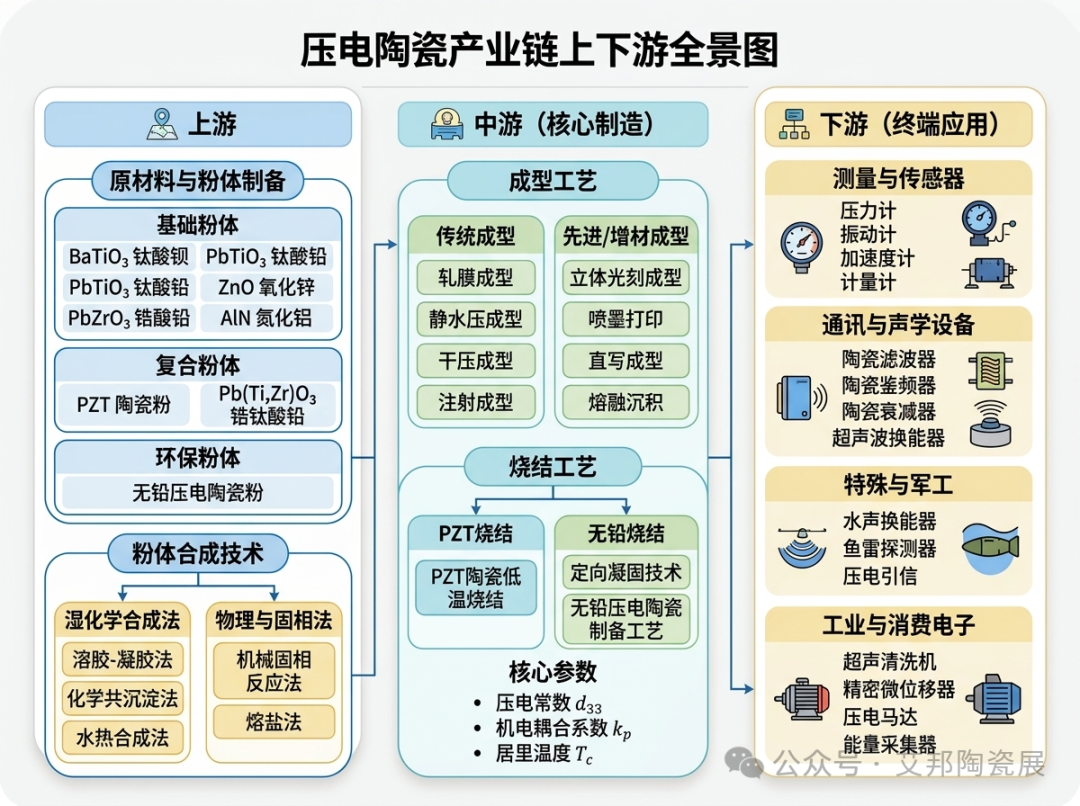
The manufacture of piezoelectric ceramics requires subjecting ferroelectric ceramics to a polarization process under a DC electric field to induce the piezoelectric effect. Key production steps include batching, mixing and milling, calcination, secondary milling, granulation, forming, binder burnout, sintering, shaping, electrode application, high-voltage polarization, and aging testing.
In recent years, driven by the rapid development of emerging sectors such as new energy vehicles, the Internet of Things (IoT), and smart home technology, market demand for piezoelectric ceramics has continued to rise. In 2024, the market size of China's piezoelectric ceramics industry reached approximately 17.2 billion RMB, with steady growth projected for the coming years. Meanwhile, the global piezoelectric ceramics market is also expanding rapidly, with Asia emerging as the largest market worldwide.
However, the industry still faces challenges such as technical bottlenecks and increasingly stringent environmental regulations. Future development in piezoelectric ceramics will place greater emphasis on material performance optimization and application innovation—such as the use of lead zirconate titanate (PZT)-based and eco-friendly ceramics—as well as the integration of nanotechnology to achieve higher energy conversion efficiency and miniaturization, thereby meeting the demands of micro- and nano-electronic devices.
Against this backdrop, Aibang will host the 8th Precision Ceramics Industry Chain Exhibition and a concurrent Piezoelectric Ceramics Industry Forum on August 28, 2026, at the Shenzhen World Exhibition & Convention Center (Bao'an New Hall, Hall 7). The event will focus on piezoelectric ceramic materials, innovative application areas, market scale, and industry progress, aiming to foster collaboration across the supply chain and drive technological innovation and application expansion. We cordially invite enterprises from all segments of the industry chain to participate!
Proposed Topics (Including but not limited to)
Piezoelectric Ceramic Industry Forum (August 28, 2026, 10:00–12:00) | ||
No. | Proposed Topic | Invited Speakers/Organizations |
1 | R&D Progress on High-Performance Piezoelectric Ceramic Materials | Ganjiang Innovation Academy (CAS) / Institute of Physics (CAS) |
2 | Applications of Piezoelectric Ceramics in Consumer Electronics (Tentative) | Goertek Inc. |
3 | Applications of Piezoelectric Ceramics in Semiconductor Equipment | Harbin Institute of Technology, Shenzhen |
4 | Applications of Piezoelectric Ceramics in Ultrasonic Detection | Xi'an Technological University |
5 | Research on High-Dynamic Precision Drive and Control Technology for Piezoelectric Ceramics | Soochow University |
6 | Breakthroughs in Piezoelectric Ceramic Nanotechnology for the Semiconductor Sector | Piezoelectric Ceramic Enterprises |
7 | Endowing Robots with "Acute Tactile Sense": Piezoelectric Ceramic-Based Sensing and Interaction Technology | Piezoelectric Ceramic Enterprises |
8 | Current Status and Development Pathways of Lead-Free Piezoelectric Ceramic Materials | Piezoelectric Ceramic Enterprises / Universities |
9 | Analysis of the Global Piezoelectric Ceramic Market Size and Regional Competitive Landscape | Piezoelectric Ceramic Enterprises / Universities |
11 | Piezoelectric Ceramic-Based Nondestructive Testing (NDT) and Medical Ultrasound Technology | Piezoelectric Ceramic Enterprises / Universities |
12 | Opportunities and Challenges for Piezoelectric Ceramic Sensors in the IoT Era | Piezoelectric Ceramic Enterprises / Universities |
For further inquiries regarding innovative presentation proposals, please contact: Ms. Li at 18823755657 (WeChat ID: same as mobile number)
Registration Methods
Method 1: Register by adding us on WeChat and sending your business card.
Phone: Ms. Li – 18823755657 (WeChat ID)
Email: lirongrong@aibang.com

Scan the QR code to add us on WeChat and inquire about conference details.
Note: Each attendee is required to provide their information.
Method 2: Long-press the QR code to register online.

Alternatively, copy the link below into your browser to register via WeChat: