
The AI market has experienced explosive growth exceeding expectations, with leading MLCC manufacturers posting record-breaking financial results.
Leading MLCC manufacturers—including Murata, Samsung Electro-Mechanics, and Kyocera—have recently released impressive financial results driven by robust demand in the AI market. To capitalize on this rapidly growing demand and secure a larger market share, these industry leaders plan to increase their capital expenditure.
Murata Manufacturing reported record-breaking revenue of ¥502.3 billion for the first quarter of fiscal year 2026 (April 1 – June 30, 2025), a year-on-year increase of 20.7%, while operating profit rose 59.8% to ¥98.5 billion. Revenue from capacitor products reached ¥282.5 billion, up 30% year-on-year; sales of chip multilayer ceramic capacitors (MLCCs) grew, driven by demand in data center and mobile application sectors, and strong demand led to a slight decline in capacitor inventory levels. Revenue from inductors and EMI filters rose 22.4% to ¥64.3 billion, primarily due to increased demand for applications in smartphones, mobile devices, and data centers. Meanwhile, to meet this surging demand, Murata has raised its capital expenditure plan—focusing on components and modules—to a total of ¥255 billion.
In the first quarter of the fiscal year ending March 31, 2027 (April 1 to June 30, 2026), Kyocera Corporation reported net sales of 525.383 billion yen (up 9.9% year-on-year), operating profit of 49.101 billion yen (up 164.7% year-on-year), and profit before income taxes of 74.891 billion yen (up 68.1% year-on-year). Both net sales and profit reached record highs for the first quarter. This significant growth was driven by increased sales of high-value-added products, including precision ceramic components for semiconductor manufacturing equipment, semiconductor packages for AI data centers, and compact, high-capacity multi-layer ceramic capacitors (MLCCs) and tantalum capacitors designed for AI data centers. Regarding MLCCs, demand from the data center and semiconductor markets has surged; Kyocera has secured long-term supply agreements, launched a large-scale capacity expansion investment plan, and achieved both quality improvements and capacity growth by boosting yields for new products. The company plans to invest 100 billion yen to expand production capacity for AI-use MLCCs. A new factory building has already been put into operation at the Kagoshima plant, with plans to progressively install additional production equipment.
In the second quarter, Samsung Electro-Mechanics recorded sales of KRW 3.4572 trillion—a 24% increase year-on-year and an 8% increase quarter-on-quarter—and an operating profit of KRW 440.4 billion, up 107% year-on-year and 57% quarter-on-quarter. This performance improvement was driven by increased sales of MLCCs for data centers (including AI servers and networking) and automotive applications, alongside expanded supplies of high-value-added semiconductor substrates and automotive components for ADAS and autonomous driving to major global tech clients. Specifically, the Component Division posted second-quarter sales of KRW 1.6494 trillion, marking a 29% year-on-year and 17% quarter-on-quarter rise. Growth was fueled by increased sales of MLCCs for data centers—spanning AI servers, networking, and power systems—as well as expanded sales of automotive products driven by the advancement of autonomous driving technology and rising demand for eco-friendly vehicles. Looking ahead to the third quarter, demand for high-capacity, high-reliability MLCCs is expected to grow as investments in AI infrastructure continue. Samsung Electro-Mechanics plans to strengthen supply by timely developing cutting-edge AI products and to actively expand market penetration for high-capacity, high-voltage products in line with the growth of the autonomous driving and eco-friendly vehicle sectors. Furthermore, the company aims to ensure stable supply volumes based on existing long-term MLCC contracts with global clients while actively addressing requests for new contracts from other major customers.
MLCCs are core components that store electrical energy and provide a stable supply to active devices—such as APs, CPUs, and GPUs—ensuring their smooth operation. They also eliminate signal interference (noise) within electronic devices, thereby enhancing product performance and reliability. Compared to traditional servers, AI servers require higher computing power and large-scale data processing capabilities, resulting in significantly higher power consumption and heat generation; consequently, there is a growing demand for MLCCs that are miniaturized, offer ultra-high capacitance, and withstand high temperatures.
Aibang has established an MLCC industry exchange group; you are welcome to apply to join. We invite you to join the MLCC (Multi-Layer Ceramic Capacitor) industry exchange group.
Recommended Event 1: [Concurrent Exhibition Forum] The 6th MLCC Industry Forum (August 27 · Shenzhen)
(Agenda updated as of July 30)
Forum Zone 3 | August 27, 10:00–16:40 | ||
No. | Presentation Topic | Speaker / Company |
1 | Ultra-miniature, Ultra-thin MLCCs Enabling the Development of AI Chips and Advanced Packaging Technologies | Yuyang Technology |
2 | Precision Slurry Metering and Loss Optimization Mechanisms in MLCC Spiral Coating Technology | Shenzhen Zhongxinglian Technology Co., Ltd. |
3 | Application of Nano-Coulter Technology in MLCC Powder Characterization | Ma Xiaoting, Technical Director, Ruixin Zhizao (Shenzhen) Technology Co., Ltd. |
4 | Insights on Avoiding Common Pitfalls in High-End MLCC R&D | Fu Jionggui, General Manager, Guangzhou Shengli New Materials Co., Ltd. |
5 | Precision Thermal Processing: Quality Through Precision—Research on Thermal Equipment and Processes Across the Full MLCC Manufacturing Chain | Du Runsheng, Expert at CETC Group / R&D Director at Hefei Hengli |
6 | Development Pathways for MLCC Miniaturization and High Capacitance | Invited: Dalian Dalicap Technology Co., Ltd. / Shenzhen Sunway Communication Co., Ltd. |
7 | Research on Controllable Preparation and High-Entropy Doping Modification of Nano-Barium Titanate Driven by High-End Electronic Material Demands | Professor Shi Liyi, Shanghai University |
8 | Presentation Topic TBD | Dr. Qi Shishun, Deputy Dean of the Hongyuan Innovation Research Institute, Beijing Yuanliu Hongyuan Electronic Technology Co., Ltd. |
9 | Presentation Topic TBD | Dalian Overseas Huasheng |
10 | Ceramic Material Technologies for PME/BME, Pulse Energy Storage, and Microwave MLCCs | Professor Tang Bin, University of Electronic Science and Technology of China (UESTC) |
11 | Ultrafine Nano-Barium Titanate Powder Materials and Dispersion Evaluation Technologies | Dr. Lu Wei, Technical Director at Huizhou Baoshunmei Technology Co., Ltd. / Researcher at Gusu Laboratory of Materials Science |
12 | Technological Achievements in the Localization of Core Equipment for MLCC Front-End Manufacturing | Shenzhen Jinminjiang Intelligent Equipment Co., Ltd. |
13 | Presentation Topic TBD | Maiborui |
14 | Zirconia Beads / 95% Zirconia Beads: Testing Standards, Quality Control, and Manufacturer Comparisons | Ran Xintian, Sales Director, Jiaxing Jingchi Special Ceramics Co., Ltd. |
15 | Presentation Topic TBD | Chongqing University |
We are currently soliciting additional topics; recommendations or self-proposed topics are welcome. For speaking or sponsorship inquiries, please contact Ms. Li at 18124643204 (also her WeChat ID).
To register for free, please long-press the QR code to sign up online.

Alternatively, copy the link to your browser to register via WeChat:
https://www.aibang360.com/m/100307
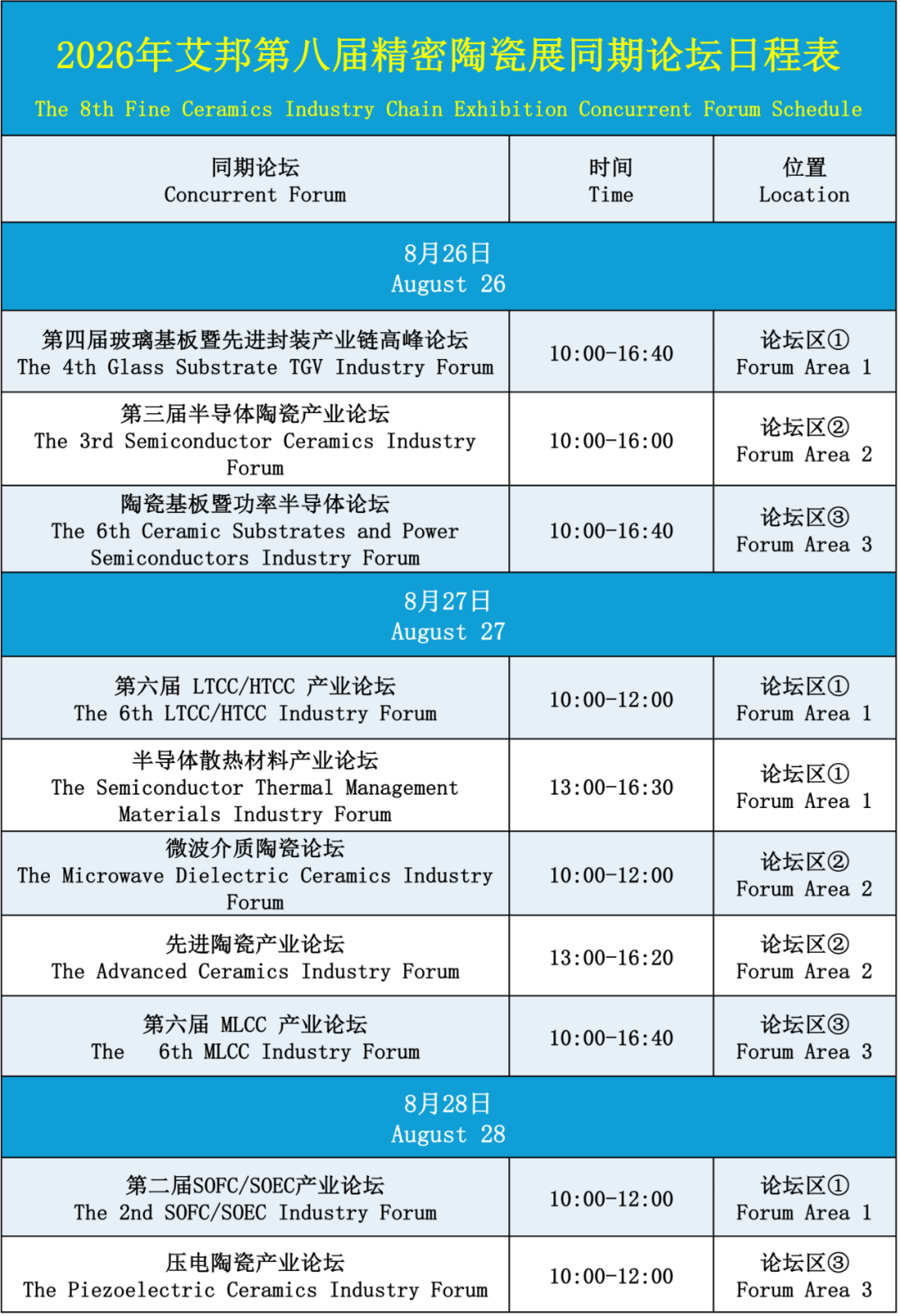
Recommended Event #2: One-click registration | Free access to the ten themed forums at the Shenzhen Precision Ceramics Exhibition (August 26–28)! Click the image below 👇 for details.
Booth Booking:
Ms. Li: 18124643204 (WeChat ID same as mobile number)
Ms. Wen: 18126443075 (WeChat ID same as mobile number)
Email: wenxiaoting@aibang.com