
How do TECs safeguard the lifeline of AI computing power in optical modules?
Amid today’s explosive demand for AI computing power, tens of thousands of optical modules within data centers transmit massive amounts of data at the speed of light. Yet, what many do not realize is that inside these modules, a tiny component—no larger than a fingernail—quietly ensures the stability of every data transmission with a precision of ±0.01°C: the TEC (Thermoelectric Cooler).
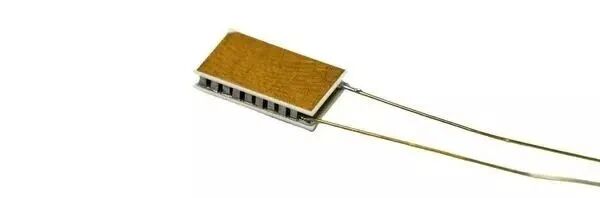
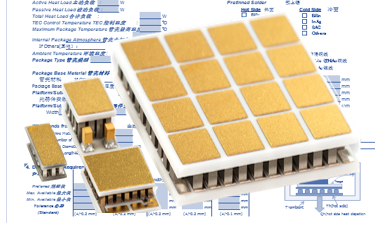
Keseda Micro TEC
1 High-speed optical modules rely on TECs
The lasers within optical modules are extremely sensitive to temperature. Temperature fluctuations trigger a series of chain reactions:
Wavelength shift: Taking the DFB laser as an example, its wavelength-temperature drift coefficient is approximately 0.1 nm/°C. Within the commercial temperature range of 0–70°C, the drift can reach 7 nm—a value exceeding the wavelength spacing of many WDM (Wavelength Division Multiplexing) systems. Such drift causes inter-channel crosstalk, leading to data transmission errors;
Power instability: Temperature changes directly affect the laser's output optical power, resulting in signal degradation;
Reduced lifespan: Prolonged operation at non-optimal temperatures accelerates laser aging and increases the failure rate.
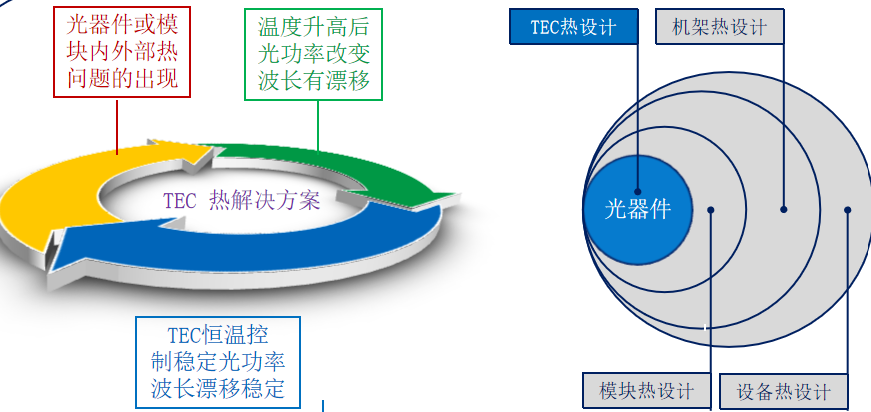
Consequently, mid-to-high-end high-speed optical modules typically feature built-in micro-TECs. Combined with thermistors and temperature control chips, these form a closed-loop thermal management system that firmly locks the laser temperature within its optimal operating range.
The core functions of the TEC within an optical module can be summarized in three points:
Stabilizing laser wavelength: Precise temperature control locks the wavelength, ensuring channel isolation and eliminating crosstalk and bit errors;
Optimizing operating conditions: Automatic cooling or heating in high- or low-temperature environments stabilizes optical power and optimizes signal quality;
Extending service life: Rapid heat dissipation slows component aging and reduces failure rates.
2 From 400G to 1.6T: Higher speeds make TECs increasingly critical
As the demand for bandwidth in AI data centers intensifies, optical module speeds are rapidly evolving from 400G to 800G, 1.6T, and even 3.2T. The power consumption and heat generation of high-speed optical modules are rising sharply, driving a corresponding surge in the demand for TECs. Requirements for Micro TECs vary significantly across different module speeds:
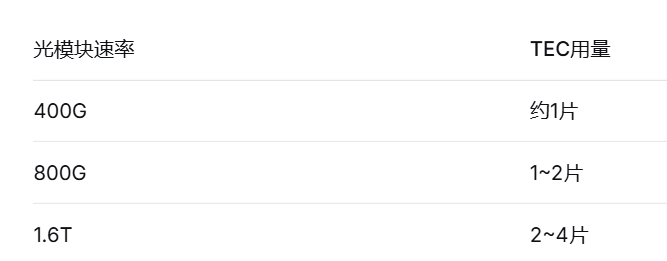
For higher data rates (such as 6.4T/12.8T) utilizing advanced packaging solutions like NPO (Near-Packaged Optics) and CPO (Co-Packaged Optics), the number of TECs (Thermoelectric Coolers) required per module may surge from single digits to dozens. Market data confirms this growth trend: the Micro TEC market within the high-speed optical module sector is projected to reach at least RMB 1.4 billion by 2026. Notably, the growth rate of demand for Micro TECs is approximately 2.5 times that of optical modules themselves. Micro TEC shipments for optical modules are expected to hit 60 million units by 2026.
3. Key Application Scenarios
TEC-equipped optical modules are utilized across a spectrum of applications, ranging from short-reach interconnects to ultra-long-haul transmission:
Long-haul backbone transmission: In DWDM (Dense Wavelength Division Multiplexing) optical modules capable of transmission distances exceeding 80 km, TECs provide precise temperature control to prevent wavelength drift, serving as a critical safeguard for backbone networks.
High-end data centers: In AI computing facilities and cloud computing centers, highly integrated chips generate significant heat; TECs provide real-time thermal management to ensure the stable operation of computing clusters.
5G/6G telecom base stations: Outdoor base stations face extreme temperature fluctuations; TECs enable bidirectional temperature control—cooling in intense heat and heating in cold conditions—to ensure optical modules operate reliably around the clock.
Coherent optical communication: In metropolitan area networks (MANs), wide area networks (WANs), and undersea cable transmission, coherent optical modules impose extremely strict requirements on optical signal phase and polarization, making the precise temperature control provided by TECs indispensable.
Industrial and specialized communications: In harsh operating environments—such as industrial automation and security surveillance—TECs ensure the stable operation of optical modules across a wide temperature range.
4. Accelerating Domestic Substitution: From "Chokepoint" Vulnerability to Breakthrough
The global high-end Micro TEC market was long dominated by overseas manufacturers such as Japan’s Ferrotec and Marlow. However, this landscape is now shifting.
Shifts in the Upstream Materials Sector:
Starting in 2026, my country will place 7N ultra-high-purity tellurium, bismuth, and bismuth telluride under export controls for dual-use items. Ferrotec and KELK—the two dominant global players in high-end TECs—lack domestic mineral resources and rely on China for over 95% of their ultra-high-purity core raw materials. With Japanese factories currently running down their inventories of high-grade single-crystal ingots, a historic window of opportunity has opened for domestic TEC manufacturers.
Technological Breakthroughs by Domestic Manufacturers:
Domestic enterprises, exemplified by Kesai-da (Kesaida), have achieved substantial progress, with product performance now on par with that of international competitors. Micro TECs for 400G/800G optical modules are already being shipped in volume, while products for 1.6T applications have entered the small-batch shipment stage.
Gaps and Advantages:
There is still a gap to close regarding domestic substitution—the yield rate for domestically produced Micro TECs is approximately 94%–95%, trailing the 97.7% achieved by Japanese and US manufacturers;
The operational lifespan is around 21,000 hours, slightly lower than the 23,000 hours offered by top-tier Japanese and US products.
However, domestic TECs are priced 10%–15% lower than Japanese counterparts, offering a significant cost advantage. Amidst intensifying US-China tech competition, the need for supply chain security is accelerating the adoption of domestic solutions by downstream manufacturers.
Source: KesaiDa (please contact for removal if infringing)
https://mp.weixin.qq.com/s/VaBNTEPDvF-uWisIKRu5Pg
On August 27, KesaiDa will participate in the Aibang Semiconductor Thermal Management Materials Industry Forum and deliver a presentation on the subject. We welcome industry peers to attend and exchange ideas!
Aibang has established a discussion group for semiconductor thermoelectric cooling (TEC) technology; simply long-press the QR code and add the administrator on WeChat to join:

Recommended Event: 2026 Semiconductor Thermal Management Materials Industry Forum (August 26, Hall 7, Shenzhen World Exhibition & Convention Center)
Conference Topics:
No. | Presentation Topic | Invited Companies (Tentative) |
1 | Research on surface modification of diamond powder and the application of diamond-copper composites in semiconductor device thermal management | Professor Wei Qiuping, School of Materials Science and Engineering, Central South University |
2 | Topic TBD | Ningbo Jingzuan Technology Co., Ltd. |
3 | Topic TBD | Xiancai (Shenzhen) Semiconductor Technology Co., Ltd. |
4 | Application of Micro-TEC (Micro-Thermoelectric Coolers) in optical modules | Liaoning Lengxin Semiconductor Technology Co., Ltd. |
5 | Topic TBD | Kesai'da (Shanghai) Semiconductor Technology Co., Ltd. |
6 | Optimization strategies for interfacial thermal resistance in diamond/copper composites | Diamond thermal management material companies |
7 | Application prospects of liquid cooling combined with diamond-based thermal management solutions in intelligent computing centers | Diamond substrate companies / Data center cooling companies |
8 | MPCVD technology optimization: Uniformity control and defect suppression | Diamond substrate/material/equipment companies |
9 | Advantages of aluminum nitride ceramic substrates for TEC (Thermoelectric Cooler) heat dissipation | Ceramic TEC companies |
10 | Thermoelectric coolers (TECs) enabling thermal management in new energy vehicles | Ceramic TEC companies |
We are currently accepting proposals for additional topics. For inquiries regarding innovative speaking opportunities and sponsorship, please contact Ms. Li at 18823755657 (also her WeChat ID).
Exhibition Booth Inquiries:
Ms. Li: 18823755657 (also her WeChat ID)
Email: lirongrong@aibang.com
Scan the QR code to add us on WeChat and inquire about exhibition details.

Long-press the QR code to register online:

Alternatively, copy the URL to your browser to register via WeChat:
https://www.aibang360.com/m/100312