
Research on the Development of the Microwave Dielectric Ceramic Industry System
From August 26 to 28, companies across the microwave dielectric ceramic supply chain—including Jiali Electronics, Nanjing Yitai, Yuanliu Hongyuan, Xinxin Intelligent, and Chuangxinqi—will gather at the Shenzhen Precision Ceramics Exhibition. We welcome you to visit and exchange ideas! For exhibition inquiries, please contact Ms. Li at 18823755657 (also her WeChat ID).
01 Introduction to Microwave Dielectric Ceramics
Microwave Dielectric Ceramics (MWDC) are a class of functional ceramic materials that serve as dielectrics in microwave circuits. Operating within the microwave to millimeter-wave frequency range (300 MHz to 300 GHz), they are used in critical passive components such as resonators, filters, and antennas. As key strategic materials for modern communications, they find widespread application in fields including telecommunications, navigation, radar, and satellite systems.
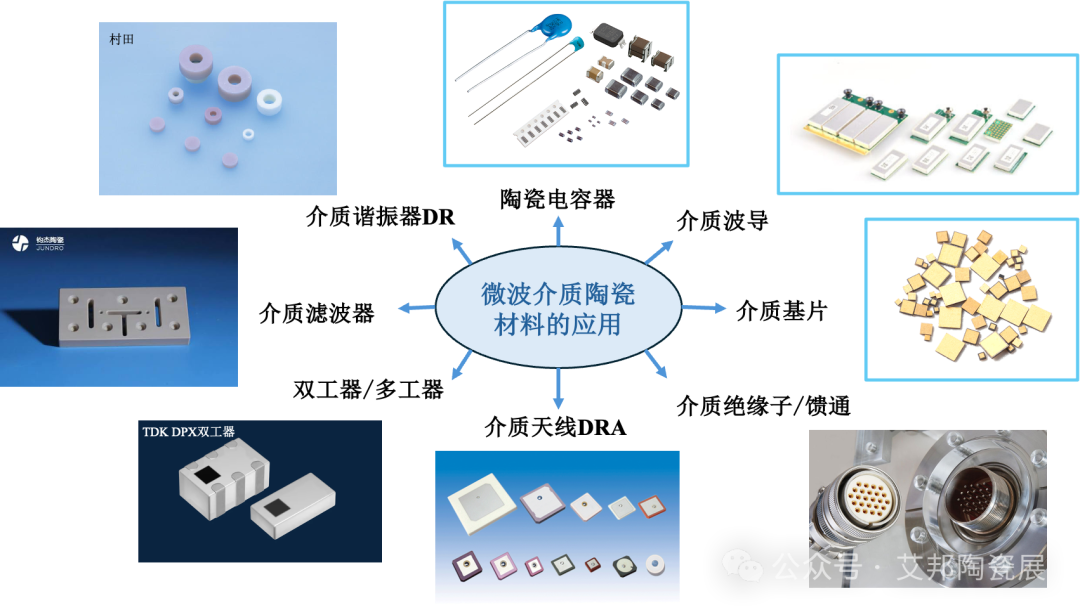
With the rapid development of technologies such as the Internet of Things (IoT) and 5G/6G communications, there is a growing demand for microwave dielectric ceramics. These materials must possess excellent properties—such as a wide range of dielectric constants, low microwave loss, and low temperature coefficients—and be suitable for manufacturing various microwave devices that meet the requirements for miniaturization, integration, high reliability, and low cost in microwave circuits.
02 Main Classifications of Microwave Dielectric Ceramics
A wide variety of microwave dielectric ceramic systems have been developed to date; these can generally be categorized into three types: low, medium, and high dielectric constant ceramics.
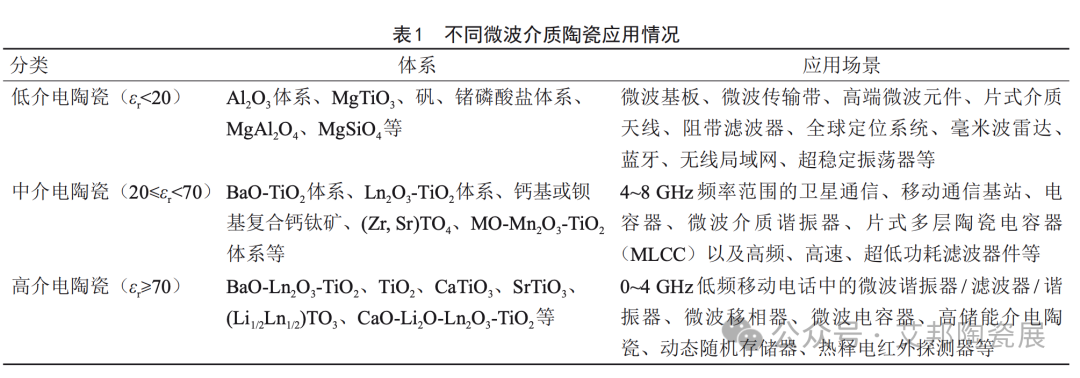
As fundamental materials for wireless communication, microwave dielectric ceramics play an irreplaceable role in 5G technology. Currently, research efforts worldwide are focused on—and challenged by—two specific types of dielectric ceramics: those with a relative permittivity (εr) of ≥60 for mobile communications, and those with an εr of ≤30 for integrated dielectric waveguide circuits in millimeter-wave and sub-millimeter-wave applications. As the commercialization of 5G expands, R&D initiatives targeting key materials for various 6G technological pathways are already underway, creating an urgent need for microwave dielectric ceramics capable of meeting the requirements of specific frequency bands across the communications sector.
Key Parameters
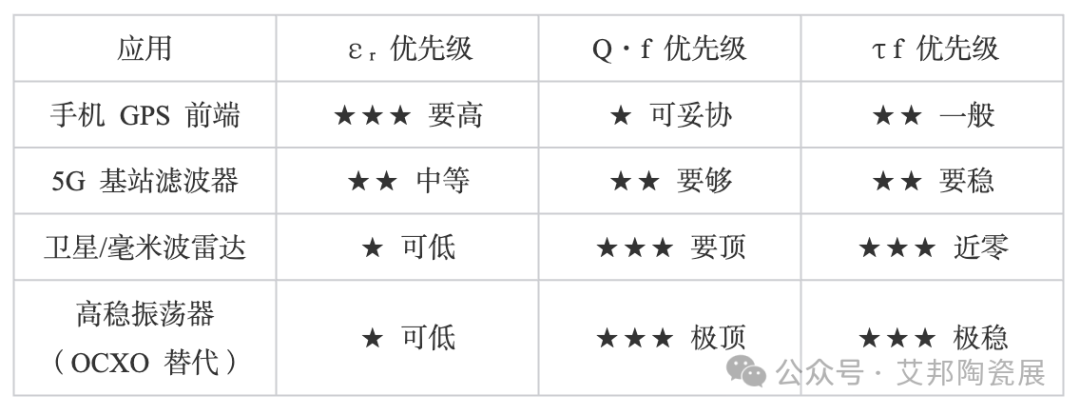
Performance evaluation metrics for microwave dielectric ceramics include relative permittivity (εr), quality factor (Q×f), and temperature coefficient of resonant frequency (τf).
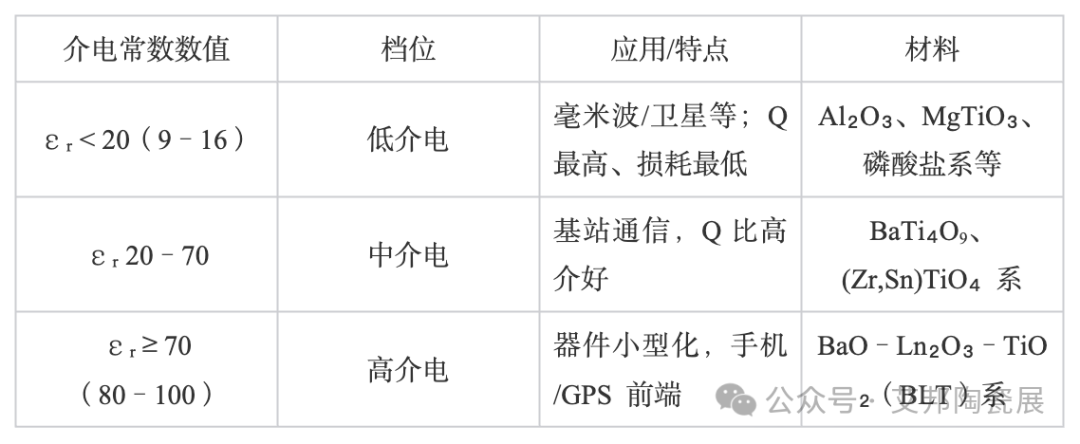
Relative Permittivity (εr):
A higher relative permittivity (εr) indicates a greater capacity for the ceramic component to store electromagnetic waves, which facilitates component miniaturization. In engineering practice, this is typically measured using the resonant cavity method (employing cylindrical samples in the TE₀₁δ mode), with measurements usually referenced at 10 GHz or at specific application frequencies. Different application scenarios require products with varying permittivity values:
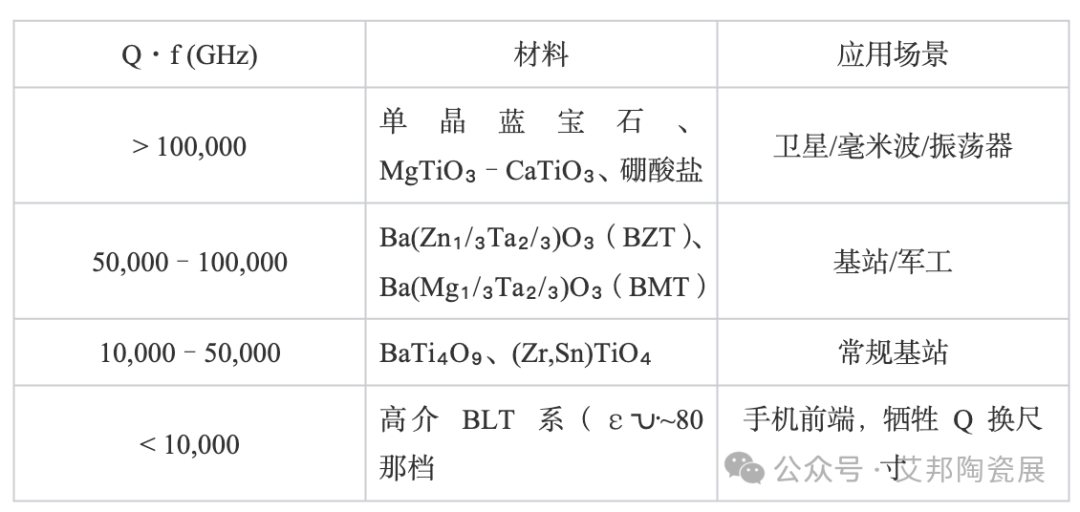
Q×f Quality Factor:
Q = 2π × (Energy Stored / Energy Dissipated per Cycle); the higher the Q, the lower the loss. Here, f is the test frequency in GHz. Since dielectric loss itself increases linearly with frequency (tan δ ∝ 1/Q ∝ f), the Q·f product represents an intrinsic material property that is independent of the test frequency.
Temperature coefficient of resonant frequency (τf):
This parameter indicates the resonant frequency drift (in ppm) per 1°C change in temperature and serves as a measure of the temperature stability of microwave dielectric materials and devices. The ideal value is τf = 0; the closer the value is to zero, the better the material's thermal stability. A high τf value can cause the passband of a base station filter to drift, leading to interference with adjacent channels, which necessitates periodic calibration or the implementation of temperature control systems.
It is difficult to optimize all three parameters simultaneously: a high dielectric constant (εr) often results in a low Q·f value and increased loss, while making it harder to control τf. Therefore, the appropriate parameter values and products must be selected based on specific application requirements.
03 Development History and Current Status of Microwave Dielectric Ceramics
International
In 1939, the American scholar Richtmeyer first proposed the concept of the dielectric resonator, marking the beginning of research into microwave dielectric ceramic materials. In the 1970s, the United States successfully developed BaTi4O9 material with a dielectric constant of 38. During the same period, Japan developed high-performance materials such as Ba2Ti9O20 ceramics and achieved commercial application in the 1980s; dielectric ceramic manufacturers such as Murata, Panasonic, and NGK Insulators gradually captured a significant share of the global market. Research into microwave dielectric ceramics in Europe and other regions began at a later stage.
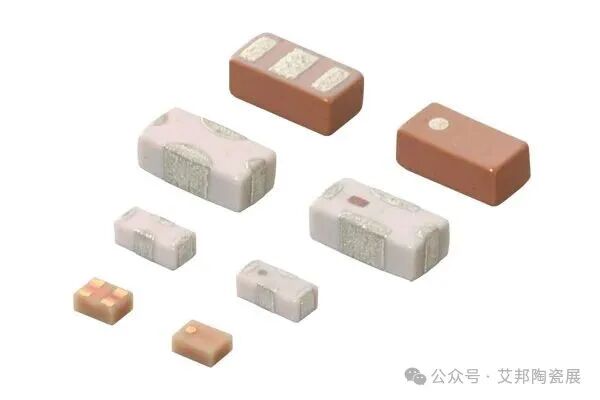
村田LC滤波器
The global market for microwave dielectric ceramics has currently reached a stage of mature development, with key players in research and manufacturing located in Japan, the United States, Europe, and China. Japanese companies, in particular, possess extensive technical expertise and comprehensive product portfolios, commanding over 90% of the market share for high-performance microwave dielectric ceramics in my country. Major international suppliers of ceramic powders—such as Japan’s Tokuyama Corporation, Sumitomo Chemical, Murata, and Kyocera, as well as the U.S.-based Ferro Corporation—dominate the high-end segment of the global ceramic powder market.
Company | Core Business/Products |
Murata Manufacturing | Dielectric resonators, dielectric filters, microwave/RF ceramic components, LTCC substrates and green tape systems, etc. |
Kyocera | Microwave dielectric devices and materials, ceramic resonators, filter assemblies, LTCC/HTCC multilayer substrates, etc. |
TDK | Dielectric filters, resonators, LTCC passive networks, RF filter/duplexer components, etc. |
CoorsTek | (USA) |
Ceramic antennas, RF and microwave components, etc. | Trans-Tech |
(USA; now part of Skyworks) | Dielectric resonators, ceramic band-pass filters, ceramic resonators, etc. |
(Information sourced from the internet; contributions from additional enterprises are welcome.)
Domestic
my country’s microwave dielectric ceramics industry started relatively late, with research and development efforts beginning in the 1980s and 1990s. Significant progress has since been made in areas such as material preparation, performance optimization, and application. Domestic demand for microwave dielectric ceramics is robust—particularly in sectors like electronics, fiber-optic communication, and national defense—leading to continuous market expansion; the market size reached 9.225 billion RMB in 2025, representing a year-on-year increase of 8.52%.
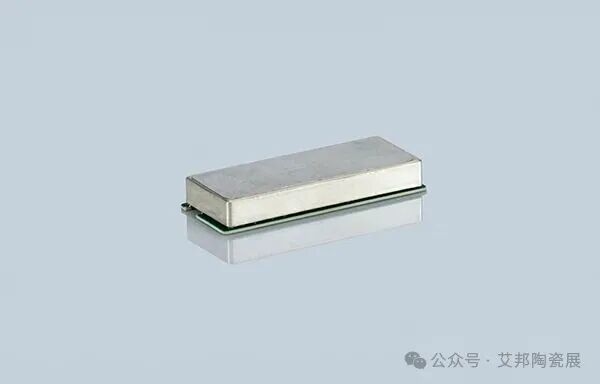
DaFu Technology Dielectric Waveguide Filters
There remains a gap between domestic microwave dielectric ceramic powders and the specialized powders produced in Japan; the number of upstream powder material enterprises is limited—with even fewer operating in the high-end segment—necessitating intensified research and manufacturing efforts in this area. Regarding industrialization, Huawei’s adoption of dielectric waveguide filters for 5G base stations ushered in a period of rapid development for my country’s microwave dielectric ceramic materials industry, driving process optimization and improvements in product consistency and production efficiency. While the competitive landscape is characterized by trends toward miniaturization and diversification, significant disparities persist compared to renowned international companies in terms of technological expertise, product variety, and the scale of industrialization.
Company Name | Core Business |
Fenghua Advanced Technology (000636) | Powder materials, filters, duplexers, ceramic antennas, etc. |
DaFu Technology (300134) | Powder materials, dielectric filters, dielectric resonators, etc. |
CETC Institute 13 | Dielectric filters, ceramic antennas, dielectric resonators, packaging housings, etc. |
CETC Institute 55 | Packaging housings, low-loss ceramic materials, etc. |
Canqin Technology (688182) | 5G dielectric waveguide filters, powder materials, duplexers, couplers, filters, resonators, ceramic antennas, etc. |
Guoci Materials (300285) | Microwave dielectric ceramic powders |
Hongyuan Electronics (603267) | Filters, microwave modules, etc. |
Tianji Technology / Torch Electron (603678) | Microwave resonators, dielectric antennas, etc. |
Sunlord Electronics (002138) | Filters, duplexers, ceramic antennas, etc. |
Jiali Electronics (Beidou Xingtong 002151) | Filters, duplexers, resonators, ceramic antennas |
Wuhan Fingu (002194) | Microwave antennas, duplexers, filters, and other components |
Guohua Technology | Microwave dielectric materials, resonators, filters, etc. |
Guangdong Tongyu Communication (002792) | Filters, microwave antennas, etc. |
Shenzhen Guoren Communication | Filters, waveguide filters, duplexers, etc. |
Suzhou Aifu Electronic Communication | Waveguide resonators, filters, ceramic antennas, etc. |
(Information sourced online; contributions from other enterprises are welcome.)
Currently, my country’s microwave dielectric ceramic materials still lag behind advanced international standards in terms of technological R&D and market competitiveness. While the country accounts for over 40% of global production volume, its output value represents only one-quarter of the global total. Issues such as high reliance on imports, weak fundamental research, and an incomplete industrial chain regarding high-performance microwave dielectric ceramics have constrained the development of my country's high-end communications industry.
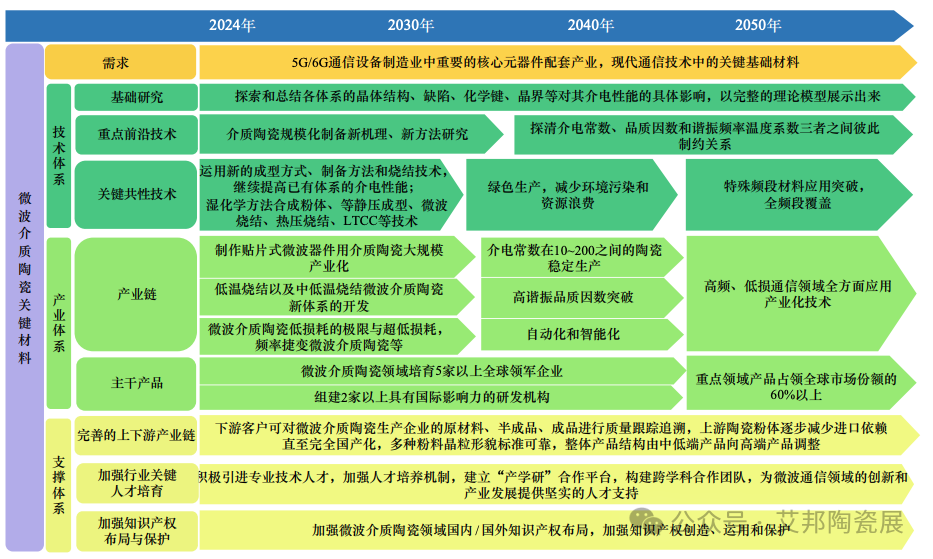
Development Roadmap for Microwave Dielectric Ceramics
The development of my country's microwave dielectric ceramic materials industry requires advancement across several fronts: industrial upgrading, material innovation, process technology improvements, and the expansion of application areas. Key priorities include achieving breakthroughs in high-performance fabrication technologies and the independent sourcing of upstream raw materials, as well as strengthening research into fundamental theories and mechanisms (such as P-V-L theory and first-principles calculations). Processes such as doping modification, fine-powder control, and low-temperature co-firing (<650°C) should be employed to balance dielectric constant, quality factor, and temperature coefficient, thereby reducing costs and enhancing reliability. To meet the demands of 5G/6G, satellite communications, and the Internet of Things (IoT), the industry must focus on high-frequency/low-loss materials, millimeter-wave dielectrics, and low-temperature dielectrics for integrated circuits. By advancing engineering and industrialization, the ultimate goal is to achieve independent supply capabilities for high-end products and transform China into a global leader in microwave dielectric ceramics.
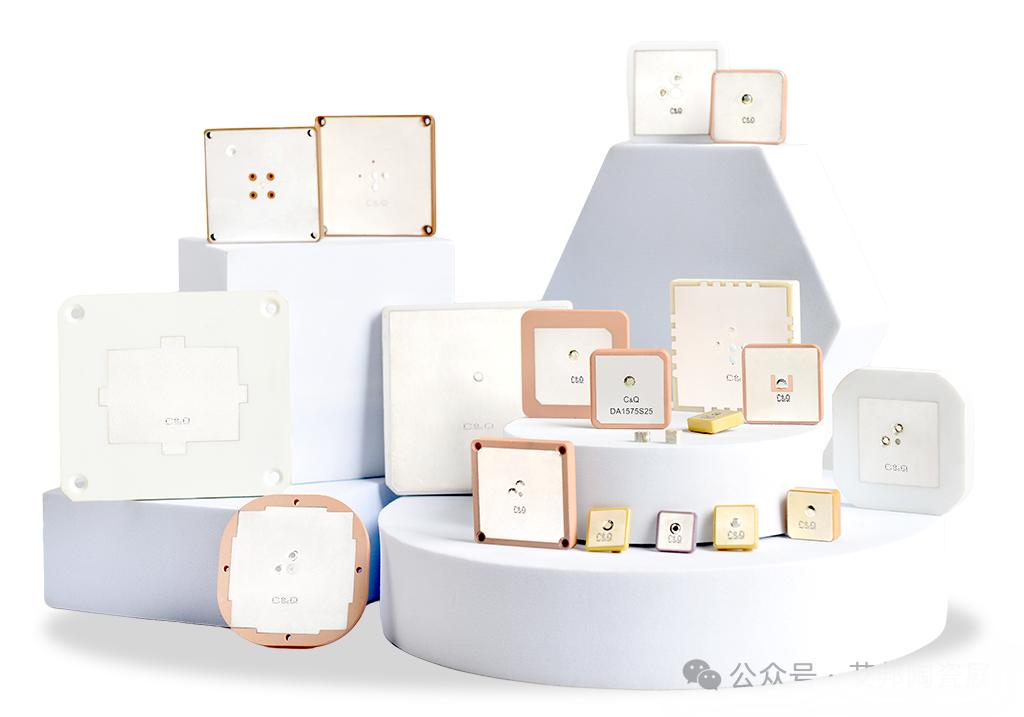
灿勤科技介质天线
Source: Research on the Development of the Microwave Dielectric Ceramic Industry Ecosystem (Miao Yang, Yang Kai, et al.)
To connect the entire ceramic antenna industry chain—spanning materials, components, and applications—Aibang has established a WeChat group for the ceramic antenna industry. Scan the QR code below and add the group admin on WeChat to join:
Recommended Event: The 8th Fine Ceramics Exhibition 2026 will be held in Shenzhen from August 26 to 28, featuring the concurrent Microwave Dielectric Ceramics Industry Forum.
Proposed Topics
No. | Presentation Topic | Invited Enterprises/Institutions |
1 | Revolutionary Applications of 3D Printing and Additive Manufacturing in Ceramic Antennas | Institute of Additive Manufacturing, Shenzhen University |
2 | Application of Dielectric Filter Materials in Ceramic Antennas | Shaanxi Ouxike Electronics Co., Ltd. |
3 | Development Requirements for Ceramic Antennas in 5G/6G RF Base Stations | Proposed: Jiaozuo Jinchuan Electronic Technology Co., Ltd. |
4 | Challenges and Solutions in the Preparation of Microwave Dielectric Ceramic Powders | Microwave Dielectric Ceramic Material Enterprises/Universities |
5 | Application of Microwave Dielectric Ceramic Materials in the 6G Sector | Microwave Dielectric Ceramic Material Enterprises/Universities |
6 | Opportunities for Ceramic Antennas in Satellite Internet and LEO Constellations | Microwave Dielectric Ceramic Material/Ceramic Antenna Enterprises |
7 | Sintering Processes for Microwave Dielectric Ceramics | Microwave Dielectric Ceramic Material Enterprises/Universities |
8 | Application of Screen Printing in Ceramic Dielectric Filters | Screen Printing Equipment/Microwave Dielectric Ceramic Material Enterprises |
9 | Application of Laser Technology in Ceramic Dielectric Filters | Microwave Dielectric Ceramic Material/Filter Enterprises/Universities |
10 | Technical pathways for achieving high-frequency and wideband performance in ceramic antennas | Microwave dielectric ceramic material & ceramic antenna enterprises |
11 | Applications of ceramic dielectric filters in the communications sector | Microwave dielectric ceramic material enterprises, filter manufacturers, and universities |
12 | Applications of high-entropy ultra-high-temperature ceramics in aerospace communications | Microwave dielectric ceramic material enterprises, ceramic antenna enterprises, and universities |
13 | Research progress on novel tungsten-bronze and niobate-based microwave dielectric ceramics | Microwave dielectric ceramic material enterprises and universities |
14 | Mechanisms regarding the influence of advanced sintering technologies (SPS, flash sintering) on microwave dielectric properties | Microwave dielectric ceramic material enterprises and universities |
15 | Engineering applications of miniaturized ceramic patch antennas in BeiDou/GNSS terminals | Microwave dielectric ceramic material enterprises, ceramic antenna enterprises, and universities |
For inquiries regarding further innovative presentations, please contact Ms. Li at 18823755657 (also her WeChat ID).
Registration Method 1: Please add the WeChat contact and send your business card to register.
Ms. Li: 18823755657 (WeChat)
Email: lirongrong@aibang.com
Scan the QR code to add on WeChat and inquire about exhibition details.

Registration Method 2: Long-press the QR code to register online.

Alternatively, copy the URL to your browser to register via WeChat:
https://www.aibang360.com/m/100309